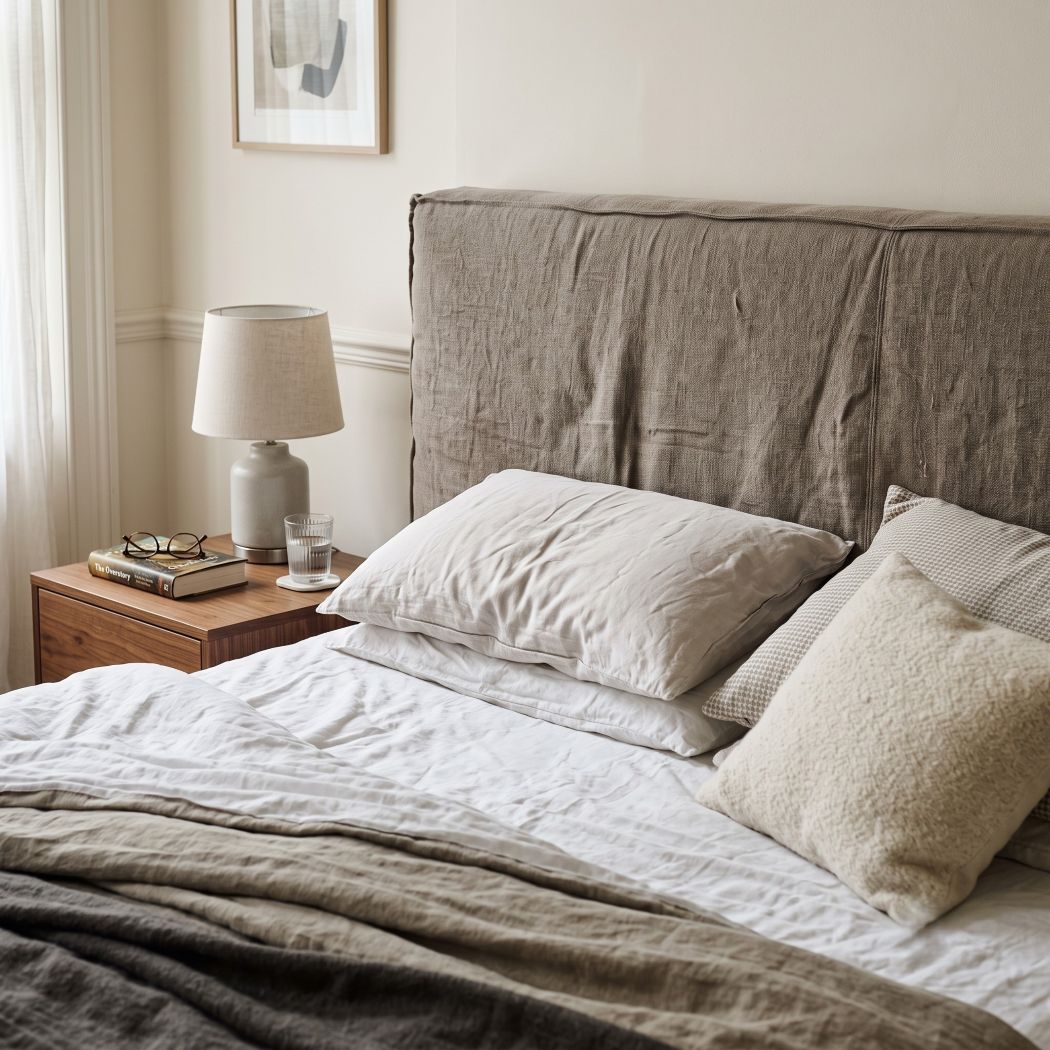
A fabric headboard takes more punishment than any other soft furnishing in the bedroom and gets cleaned the least. You lean against it every night with a warm scalp, damp hair some nights, product in it on others, and over a year or two a shadow settles at head height that the owner has long stopped seeing. The first time I point it out, half the time the reaction is mild horror. It was there the whole while.
Upholstered bed frames are quieter about it. The side rails and the base gather dust and the odd spill, and because they sit low and in shadow you don’t clock any of it until the day you shift the bed to hoover underneath.
Neither job is hard. Both are easy to wreck by getting the fabric too wet – on a headboard, a soaking means the foam behind the fabric stays damp for a week and turns musty. That’s most of what this piece is about.
Why does a fabric headboard get dirty in the first place?
Heads, mainly. The back of a head resting on fabric every night leaves sebum – scalp oil – along with whatever’s sitting in the hair, from dry shampoo to wax to yesterday’s serum. It transfers invisibly and oxidises to a dull grey-brown over months. You never catch it happening. You just notice, one grey January afternoon, that the pale linen behind the pillows has a darker bloom to it.
Then there’s the rest: dust on the top edge, skin flakes working into a buttoned surface, the occasional cup of tea in bed that ends where tea in bed ends up.
The head-height mark nobody wants to look at
That mark is grease, and grease is why a dry vacuum and a wipe won’t shift it. Fresh, light marking lifts with upholstery shampoo foam. Once it’s built up and oxidised over a couple of years it needs a proper solvent or an enzyme cleaner and a great deal of patience, and even then a very pale linen may hold a ghost of it. Set expectations before you start. A ten-year-old headboard in ivory will not come back to showroom white, and anyone who tells you it will is selling something.
What do the cleaning codes on the label actually mean?
Every proper upholstered headboard has a care label, usually stitched into a back seam or the underside. On it is a single letter telling you what you’re allowed to put on the fabric, and ignoring it is how people bleach a stripe into a sofa.
W means you can clean it with water-based products – upholstery shampoo, essentially. S means solvent only; you use a dry-cleaning solvent and keep water off it. WS means either is fine, which gives you the most room to work. X means neither: vacuum only, no wet cleaning of any kind.
For my money the label is worth ten minutes of hunting for before you touch a drop of anything. Half the headboards I see have never had theirs read.
When the label says X (vacuum only)
An X code usually means a delicate or non-colourfast fabric where any moisture will mark or shrink it. Some linens and wools, a lot of the pale boucle that’s everywhere now. You’re limited to dry methods: thorough vacuuming with the upholstery tool and a soft brush to lift the pile. For a greasy mark, a light dusting of dry-cleaning powder left to sit, then brushed and vacuumed back out. It’s less satisfying than a wet clean and it’s the only safe route. Push water into an X-code fabric and you’ll trade a grease mark for a permanent water ring, which is the worse of the two.
How do you clean a fabric headboard without soaking the foam?
This next bit is where headboards get ruined, so take it slowly.
Vacuum first, always, with the upholstery nozzle, then the crevice tool down every seam and around every button. You’re lifting loose dust and grit that would otherwise turn to grey slurry the second it met your cleaning foam. Skip this and you grind grit into the weave.
Test your product on a hidden patch – the back, or the underside near the label. Wait for it to dry. A colour run or a lightened patch means stop.
Now the clean itself. Mix upholstery shampoo – Vanish or the like – and whisk it to a dry foam, the drier the better. You want foam on the cloth, not liquid. Work in small sections with a barely-damp microfibre, wiping in the direction of the weave, lifting the dirt onto the cloth and turning to a clean face often. The single biggest mistake is loading the cloth with water because it feels as though it’ll clean faster. It won’t. It’ll push moisture through to the foam pad, and that pad is sealed inside fabric with nowhere to breathe. A damp foam core in a warm London bedroom grows mould you can’t see and can very much smell.
Once a section’s clean, go over it with a second microfibre wrung out in plain water to lift the shampoo residue, then press a dry towel on to pull the moisture back out. Then leave it. Window open, or a fan pointed at it, and give it hours before the bed goes back against the wall.
One firm view, since people ask: keep a handheld garment steamer well away from an upholstered headboard. Steamers get sold as a miracle for freshening fabric, and on a hanging curtain they’re fine, but a headboard is a foam sandwich and steam is water you can’t control. You drive it straight into the pad, it can’t get out, and a fortnight later there’s a smell. I’ve been called to two of those this year and both started with a steamer.
Buttoned and tufted headboards – getting into the dips
Deep-buttoned headboards, the Chesterfield-style ones, are dust magnets. Every button sits in a well and every well collects fluff and grit that the flat upholstery tool skates straight over. Get in there with the crevice tool first, then a soft nail brush or an old toothbrush to loosen what’s compacted around the button itself. For the fabric folds fanning out from each button, work the foam along the fold rather than across it, or you’ll drive dirt deeper into the crease. It’s slow. A well-buttoned king-size headboard is a good forty minutes before you’ve touched the flat panels.
What about velvet, and does it need different handling?
Velvet needs a gentler hand and one rule you don’t break: mind the pile direction. Velvet has a nap, a direction the fibres lie in, and cleaning against it or drying it wrong leaves patches that catch the light differently and read as stains even when they’re clean.
Vacuum with a soft brush attachment, going with the pile. Spot-clean sparingly. When you’ve cleaned a patch, brush the whole pile back one way with a soft cloth while it’s still slightly damp so it dries uniform. Cotton and synthetic velvets take light water-based cleaning; the older silk and viscose velvets are an S-code job, and I turned down a wet clean on a viscose headboard in a Maida Vale mansion flat for exactly that reason.
Lifting a water ring and resetting the pile
If velvet’s already got a water ring – someone dabbed a spill and left a tide-line – you can often lift it by dampening the whole panel evenly with distilled water on a sponge, so there’s no hard edge left anywhere, then brushing the pile flat one way and letting it dry slowly. That resets the light-catch. It doesn’t always work, and on crushed velvet it can make things worse, so test a hidden corner first.
How do you deal with damp or a musty smell behind the bed?
This is the London one. In a period flat with solid brick walls and no cavity, the external wall behind the bed runs cold, and a padded headboard pressed flat against it traps warm bedroom air where it meets that cold surface. Condensation forms, the back of the headboard never dries, and black spotting creeps across it.
I cleaned a bedroom in a top-floor flat on Tressillian Road in Brockley where the linen headboard looked spotless from the front and the back was half-covered in mould, the wall behind it beaded with damp. No amount of cleaning the fabric would have fixed it. The cause was a bed shoved tight to a cold, unventilated wall.
The fix is airflow. Pull the bed three or four inches off the wall so air can move behind it. Wipe existing mould off the fabric back with a diluted anti-mould solution, test-first as ever, and dry it hard. If the wall itself is spotted, that’s a damp problem bigger than the headboard and wants looking at properly. A musty smell with no visible mould usually means moisture has got into the foam – from over-cleaning, or from that same cold-wall condensation – and the only cure is drying it right through: days near a dehumidifier, not a quick blast with the hairdryer.
Prevention is the easier half. Keep that few-inch gap permanently on any bed against an outside wall; if the room won’t allow it, a wall-mounted headboard fixed slightly proud of the plaster does the same job by letting air track behind. Open the window for ten minutes each morning while the bed’s still warm, so the damp breath of a night’s sleep has somewhere to go other than the coldest surface in the room. None of it is dramatic. It’s the difference between wiping a headboard back once and wiping it every spring.
The upholstered side rails and base
The rails and base of an upholstered divan get forgotten because you can’t see the tops of them under the mattress and the sides sit in shadow. Lift the mattress off once a year and vacuum the platform and the inside faces of the rails, where dust and hair collect along with the odd dropped tablet. The outward faces take scuffs from slippers and the vacuum cleaner itself, and those come up the same way as the headboard – dry foam, barely-damp cloth, patience.
Pull the bed out from the wall while you’re at it and leave it a few inches proud when it goes back.