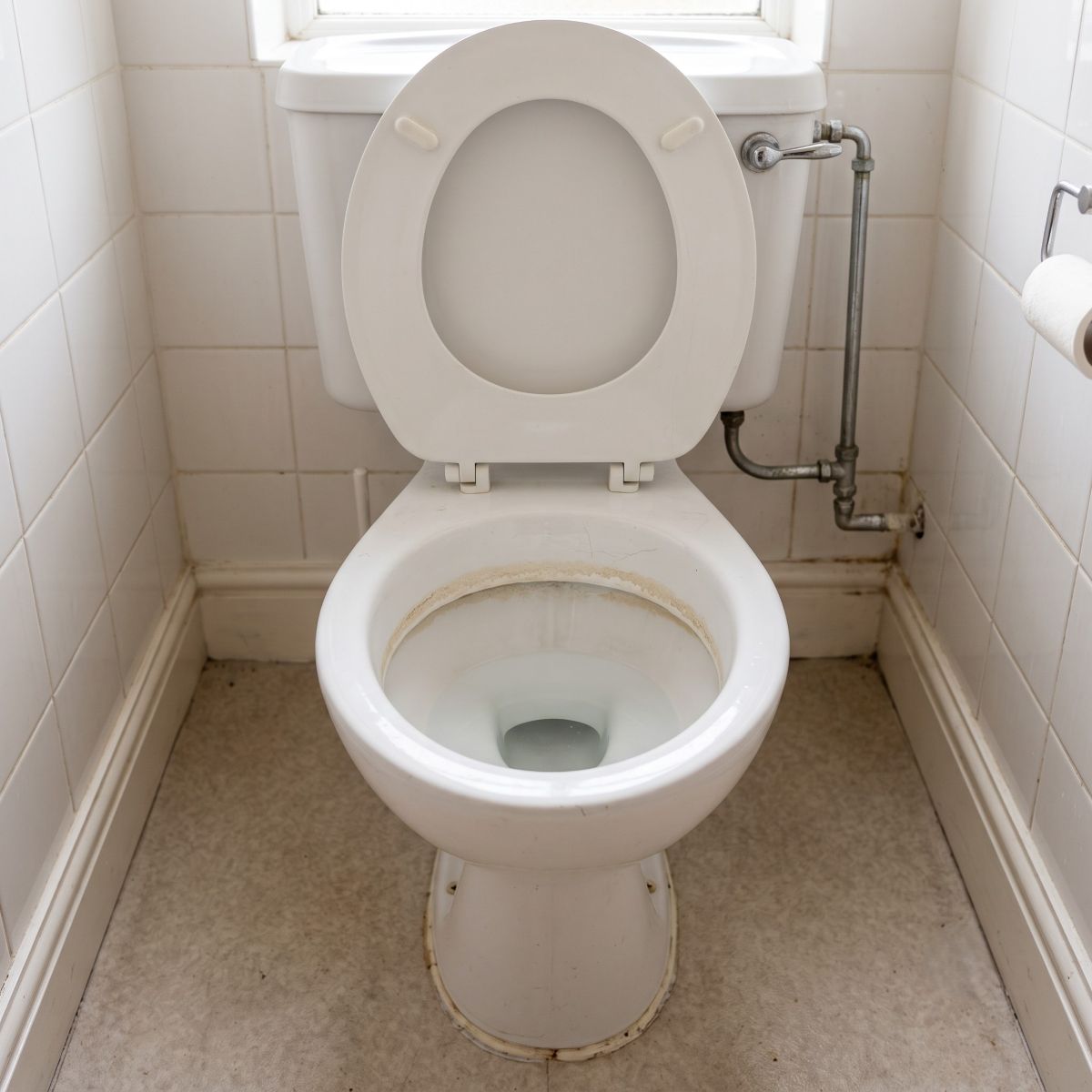
Every toilet in London ends up with it. A chalky ledge at the water surface, a brown ring sitting on it, and worse, a rough crust below the line that you can feel with the brush but can’t seem to move. That’s limescale. London water is drawn off the chalk aquifer under the city, and it’s about as hard as water gets in Britain – north and east London hardest of all.
The below-waterline scale beats most people for one reason: they keep pouring bleach in. Bleach whitens the brown and kills the smell for a day, and the hard scale sits there untouched, because bleach was never going to dissolve it. You want acid, and you want the standing water out of the way so the acid can reach the scale instead of being swallowed by half a litre of toilet water.
Why won’t bleach shift limescale below the waterline?
Limescale is calcium carbonate – chalk, more or less. It sits dissolved in hard water, and every time the bowl stands still a little comes out of solution and cements itself to the china right at the waterline, where water meets air. Layer on layer over months, and you’ve a hard off-white crust that a brush skates across.
Bleach is a whitener and a disinfectant. It lightens the brown organic staining and the iron in the scale, so the pan looks cleaner for an afternoon. The deposit underneath stays exactly where it was. Chalk dissolves in acid, and bleach sits at the alkaline end of things, so it was never the tool for this. It only ever touched the surface.
Mind you, plenty of people have bleached the same brown ring every week for years without once asking why it always comes back.
What the brown ring actually is
The ring is two problems stuck together. Underneath is the scale, hard and porous. The staining bonds into that porous surface – iron and a little manganese, with organic matter from the water soaked in on top – like ink into blotting paper. That’s why scrubbing the surface never clears the colour: the colour lives inside the deposit. Take the scale off and the stain goes with it. Leave the scale, bleach the top, and you’re back in a week.
How do you get the water out of the way first?
Below the waterline means underwater, and you can’t dissolve scale through six inches of dilution. So the first move, every time, is to drop the water level and expose the scaled band.
The water you see is held there by the U-bend – the trap – which is designed to keep a plug of water sitting in the pan as a seal against drain smells. That’s why the level always returns to the same spot no matter how much you bail: the bowl refills to the height of the bend. Even an hour of dry scale is the whole reason for dropping it.
The thorough way: find the isolation valve on the supply pipe feeding the cistern – a small valve with a screwdriver slot, usually low on the pipe behind or beside the pan. Turn it a quarter-turn with a flathead to shut the water off, flush to empty the cistern, and it won’t refill. Now bail the bowl. A plastic cup for the bulk, a sponge for the last of it, until the scaled ring sits in open air. Wear gloves for that bit; it’s toilet water and you’re about to work up close.
Dropping the level without turning the water off (the quick method)
If you can’t find or shift the isolation valve, you can still drop the level. Push a toilet brush hard down into the U-bend a few times, or tip a bucket of water in fast from height – both shove the standing water over the bend and leave the bowl sitting lower. Sponge out what’s left in the base. It’s less tidy than shutting the supply off, and the level creeps back up over an hour, but for a single descaling session it’s enough to get acid onto dry scale.
Which acid actually dissolves the scale, and how long do you leave it?
Now the water’s gone and the scale’s exposed. Onto the acid.
White vinegar gets recommended everywhere, and I’ll be straight: on heavy toilet scale it’s oversold. It’s weak acetic acid, and it’ll handle a light film or a kettle’s worth of fur given a night to work, but against a two-year crust below a London waterline you’ll pour in a bottle, wait until morning, and find it barely started. Fine for maintenance, out of its depth on the real thing. Mind you, it’s cheap and it’s under every sink, which is half of why it keeps getting recommended.
Citric acid is the step up most people can safely keep in the cupboard. Two or three tablespoons of the crystals in a little hot water, poured onto the exposed scale, left for a few hours. It clings poorly on a curved surface, though, which is the recurring trouble below the waterline – the acid runs off the scale and pools in the bottom where there’s nothing to dissolve.
The fix for that is contact time and cling. A toilet-specific limescale gel is built to stick to the china and stay on the scale. Better still for a stubborn band: lay a poultice. Soak strips of toilet roll in your acid, press them flat against the scaled ring so they hold the acid there, and leave them an hour or two. The paper keeps the acid in contact instead of letting it slide to the bottom of the bowl.
Then there are the trade acids, like phosphoric and the strong one, hydrochloric – sold as brick acid. They work fast and they demand respect: fumes, splashes that burn, a real risk of etching the glaze or wrecking any chrome or plastic they touch. I use them when a job warrants it, diluted and ventilated and never left long. For a home toilet, citric or a proper gel does almost everything brick acid does with a fraction of the danger.
One thing to make peace with: a heavy ring is rarely one pass. On a crust that’s years deep you’ll soak it, leave it, scrape off the softened top layer with a plastic scraper or the pumice, then wet a fresh poultice and go again. Two or three rounds is normal, and the second round always shifts more than the first because the acid has already opened the surface up. The mistake is losing patience after one go and jumping straight to brick acid – the scale doesn’t need more aggression, it needs more time in contact.
When to reach for a pumice stone, and when not to
Once the acid has softened the crust, a pumice toilet stone shifts what’s left. A pumice stone kept wet abrades hard scale off vitreous china without scratching the glaze – wet is the whole condition, because a dry pumice on dry china will score it. Work gently, keep both stone and surface wet, and let the softened scale come away.
What you never take pumice to: coloured or coated pans, acrylic, enamel, chrome fittings, the shiny trip lever. Pumice is for white vitreous china and nothing else. If you’re unsure what the pan’s made of, test low down where it won’t show.
What are the dangers you need to respect?
Two of them, and one can put you in hospital.
The first is the glaze. Acids etch vitreous china if they’re too strong or left too long, and once the glaze is micro-roughened, scale grips it faster than before and the whole thing turns into a recurring fight. Strong acid, short dwell, thorough rinse. Don’t walk off and leave brick acid sitting in a bowl for the afternoon.
Never mix it with bleach
The second danger is the one people walk straight into. Acid and bleach together give off chlorine gas, which is dangerous in an enclosed room like a small London bathroom. If you’ve been cleaning the toilet with bleach, or there’s a bleach-based block in the cistern, rinse everything through thoroughly before you put any acid near it. Never pour a limescale acid into a bowl you’ve just bleached. Work with the window and door open, wear gloves and eye protection, and if you catch a sharp acrid smell, get out and let it clear.
How do you stop the ring coming back?
A flushed, used toilet scales far slower than one that stands still – a guest bathroom or a holiday-home pan is where the worst rings grow, because the water sits undisturbed for weeks on end. A monthly hit of citric on the waterline keeps a maintained toilet clear in ten minutes.
The syphon jets under the rim scale up too, which chokes the flush and leaves streaks down the bowl. That’s a rim job rather than a waterline one, but the same citric soak up under the rim clears them.
Those blue in-cistern blocks I’d leave on the shelf. They dye the water and do next to nothing about scale, and the bleach ones set you up for the exact acid-plus-bleach problem above.
The point where you should just replace the pan
I part company with most cleaners on this one. A toilet that’s been left to scale and etch for a decade – glaze gone matt and pitted, scale rebuilding within days of every clean – is often past saving, and I’ll tell a client to replace the pan rather than keep pouring acid down it. A new close-coupled pan is cheap. The hours of brick acid and pumice you’d spend nursing a ruined one, over the years left in it, cost more than the ceramic does.
I said exactly that to a landlord over a rental on Ferme Park Road in Crouch End last spring. The bowl had been scaled and bleached by tenants for years, the glaze was shot, and no acid was bringing it back. He replaced it for eighty quid. A flat I look after in Walthamstow went the same way a month later, and the new pan there hasn’t scaled since.