Most of the black on a main-road windowsill is tyre and brake.
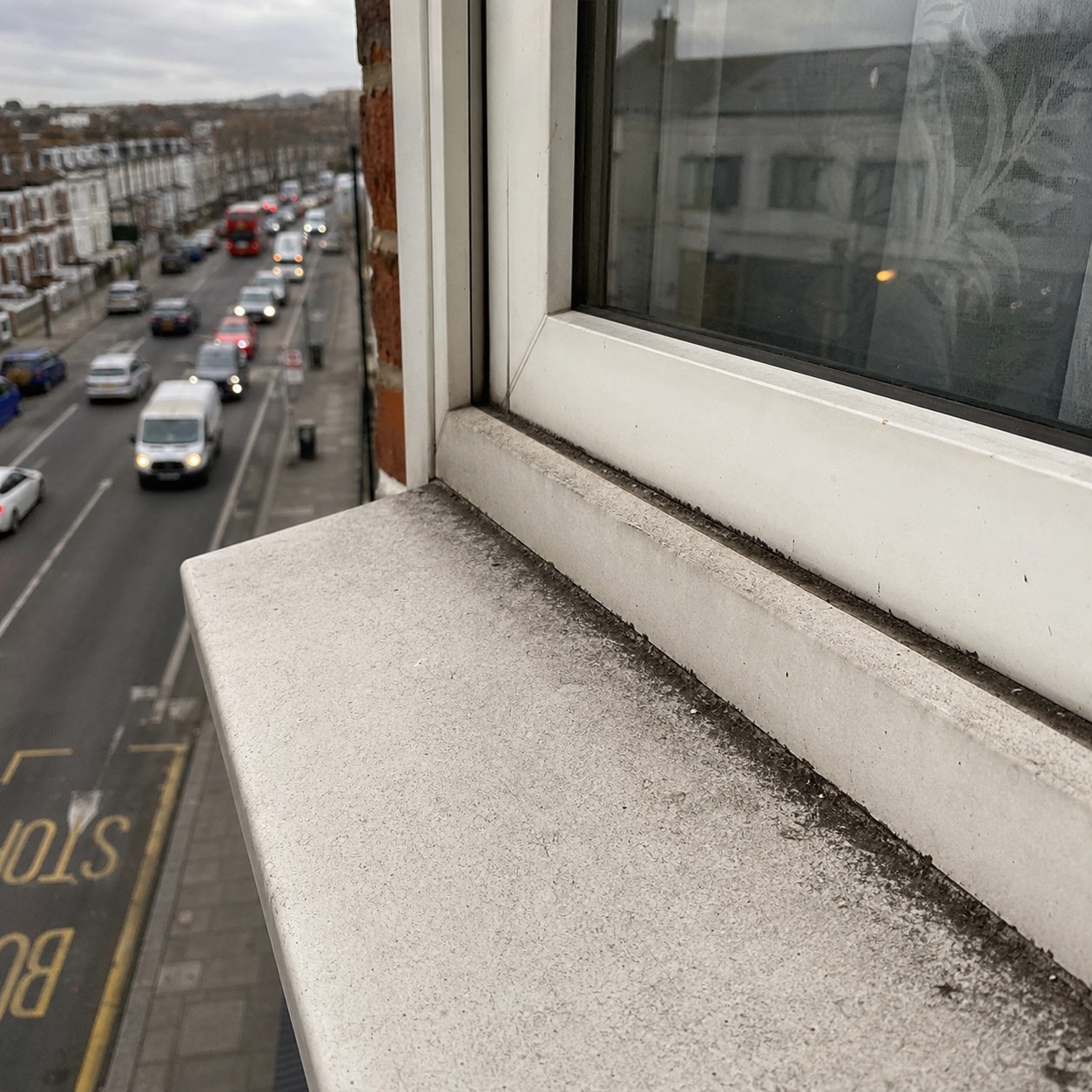
People assume soot, and soot in the chimney sense has been a minor part of the mix in London for decades. What settles on a sill fronting the A13 or the Seven Sisters Road is a composite: rubber and road-surface fragments, iron and copper filings from brake discs and pads, bitumen dust, diesel black carbon in smaller proportion than it used to be, and a binding of semi-volatile hydrocarbons that turns the whole thing from a dust into a film.
That distinction is the reason your sill behaves the way it does. Dust wipes. Film smears and then re-attracts. A fortnight later you are looking at the same grey-black band along the front edge, wondering whether the last clean did anything.
What Is the Black on a Main-Road Windowsill Made Of?
Non-exhaust emissions, largely. The phrase covers brake wear, tyre wear, road surface abrasion, and the resuspension of settled road dust as vehicles pass over it.
The Air Quality Expert Group found that non-exhaust sources contribute well over half of all particle pollution from road traffic in the UK, and across EU member states brake and tyre wear accounted for roughly 77 per cent of PM10 and 60 per cent of PM2.5 from road transport as of 2023. None of it is limited by legislation, and it comes off vehicles regardless of what is or is not coming out of the exhaust.
The metal content explains something people notice and cannot place. Brake and tyre wear are the primary source of atmospheric copper and zinc, with the national inventory attributing 47 per cent of copper emissions to them. Fine iron and copper particles on a damp white sill will oxidise, which is why the deposit on a north-facing sill often has a brownish undertone that reads as rust rather than dirt. It is rust. That’s the road.
Why It Smears Instead of Wiping
Because a good share of what has landed is organic and slightly tacky rather than mineral and dry. Tyre rubber, processing oils, bitumen fines from the road surface itself, and condensed hydrocarbons all arrive together and behave more like a very thin grease than like sand. A dry cloth pushes it around. A damp cloth with plain water spreads it into a haze.
The correct approach on a heavily loaded sill is a detergent that emulsifies rather than one that suspends – a general-purpose alkaline cleaner or, on the worst kerbside sills, a traffic film remover of the kind used on commercial vehicles, diluted well down.
Why Does It Come Back So Fast?
Deposition on a horizontal surface a few metres from moving traffic is relentless, and the numbers are not intuitive.
Kerbside particulate concentrations on a busy London road run several times the urban background measured a few streets back, and the gap widens for the coarse fraction that does most of the visible dirtying. Brake wear particles cluster around a mass-weighted mean diameter of two to six micrometres, and tyre wear shows peaks in both the fine and coarse ranges. Coarse particles settle out fast, which is precisely why they land on your sill and not on somebody’s sill in a cul-de-sac.
A road carrying 20,000 vehicles a day is putting that deposit down continuously, and traffic peaks correspond with braking, which is when brake material is generated. A sill outside a set of lights or a bus stop blackens faster than one mid-block on the same road. I have seen the difference across four houses in a terrace.
There is also a compounding effect nobody tells clients about. A freshly cleaned sill with a slightly abraded or chalked surface is more retentive than a smooth one, so the first week after a clean can lay down more than the second week. That’s the road, and it is also partly the cleaning.
The Difference Between the Sill and the Glass
Glass is vertical and self-cleaning to a degree, because rain runs down it and takes the loosely bound fraction with it. A sill is horizontal, has a lip that traps run-off, and sits under the window collecting whatever the glass sheds. Everything the pane loses ends up on the sill below it. Clients often ask why the windows still look reasonable while the sills look filthy a fortnight after both were done. That is geometry rather than a difference in effort.
Internal sills going black are a separate matter and get misdiagnosed constantly. Deposit on the inside of a window on a main road arrives through trickle vents, through the gap under a sash, or on the soles of shoes and the underside of an opened casement. If the inside blackens as fast as the outside, look at the vents and the seals before you look at your cleaning.
Does the Sill Material Change How Quickly It Blackens?
More than anything else you can control.
White uPVC is the common case and the worst performer once it has aged. Sound, new uPVC has a smooth, slightly glossy skin. After ten to fifteen years of UV exposure that skin chalks – the surface polymer degrades and the titanium dioxide filler becomes exposed, giving a microscopically rough, porous, faintly powdery finish. Deposit keys into that surface mechanically. Two sills on the same elevation, one replaced five years ago and one original, will look completely different a fortnight after the same clean.
Painted timber with an intact gloss or satin finish holds far less, because the film is continuous. Once the paint has gone matt or started to microcrack, it performs like chalked plastic.
Cast stone and unsealed natural stone sills are the hardest of the lot. They are porous by nature and the deposit penetrates rather than sitting on top, so no amount of surface cleaning gets them back to white. On a stone sill facing a main road my honest advice is to clean it twice a year and stop thinking about it in between.
What Chalking Does to a Twenty-Year-Old uPVC Sill
Run a dry finger along an old white sill in dry weather. If it comes away with a faint white powder, that is chalking, and it is telling you the surface has no barrier left. Cleaning that sill removes the dirt and exposes fresh chalked polymer, which then grabs the next fortnight’s deposit more efficiently than the last one did.
Which Cleaning Methods Make It Worse?
Three habits, all of them common, all of them accelerating the problem they are meant to solve.
Abrasive cream cleaners are the first. They cut through main-road film beautifully on the day and leave a field of micro-scratches, and every scratch is somewhere for deposit to lodge. The sill looks brilliant on Saturday and worse than its neighbour by the end of the month.
Solvent wipes come second. Acetone-based or strong alcohol wipes soften uPVC surface polymer and leave it duller and more absorbent than they found it.
Pressure washing is third. A lance on a uPVC sill drives water behind the trim and into the frame joint, and on chalked plastic it erodes the surface outright.
The Melamine Sponge Problem
Melamine foam sponges are sold as a miracle for exactly this job and they are an abrasive, with a hardness in the region of fine sandpaper. They work by sanding a thin layer off whatever they touch. On glazed ceramic that is survivable. On a chalked uPVC sill it is a surface treatment in the worst sense, and I would happily see them carry a warning on the packet. I have refinished sills that were ruined by a fortnightly routine with one of those sponges and nothing else.
Can You Slow It Down Rather Than Just Repeating It?
Yes, and it means treating the sill more like a car bonnet than like a worktop.
The sequence is: clean thoroughly with a traffic film remover or alkaline degreaser, rinse properly, dry, then apply a uPVC restorer to re-wet the chalked surface, and finish with a polymer sealant or a hard carnauba-based wax. What you are doing is putting a continuous, slightly hydrophobic film back over a porous one. The deposit still lands. It sits on top of the sealant instead of keying into the plastic, and it comes off next time with a damp microfibre and no chemistry at all.
On kerbside sills in Poplar I have had this halve the apparent soiling rate. There was a first-floor flat on East India Dock Road, E14, where the tenant had been doing the sills every Sunday with a cream cleaner for two years and had ground them to a dull, permanently grey finish. Restorer and sealant took an afternoon across six windows. She went from weekly scrubbing to a wipe every three weeks and stopped believing the road had personally singled her out.
Reapply the sealant twice a year, in spring and autumn. It costs about £12 a bottle and one bottle does a terraced house several times over.
The £12 Bottle That Halves the Frequency
Which brings me to the thing that argues against my own invoicing. If somebody rings and asks for fortnightly exterior sill cleaning on a main road, the right answer is to decline it and sell them one restoration visit instead. Fortnightly cleaning of an unsealed chalked sill is a subscription to a problem. I would rather do the afternoon’s work once and see them twice a year.
There is no service in charging cycle after cycle for a job that gets marginally harder each time, whatever the invoice says.
One last point on expectations. Emission standards and charging zones are built around what leaves the exhaust, and the material landing on your sill largely does not. Heavier vehicles generate more tyre and road-surface wear, and battery-electric cars are heavier than their equivalents. The sills on the Old Kent Road are not going to get cleaner because the fleet did. That’s the road, in the most literal sense available.
The tenant in Poplar keeps her sealant bottle under the sink next to the washing-up liquid.