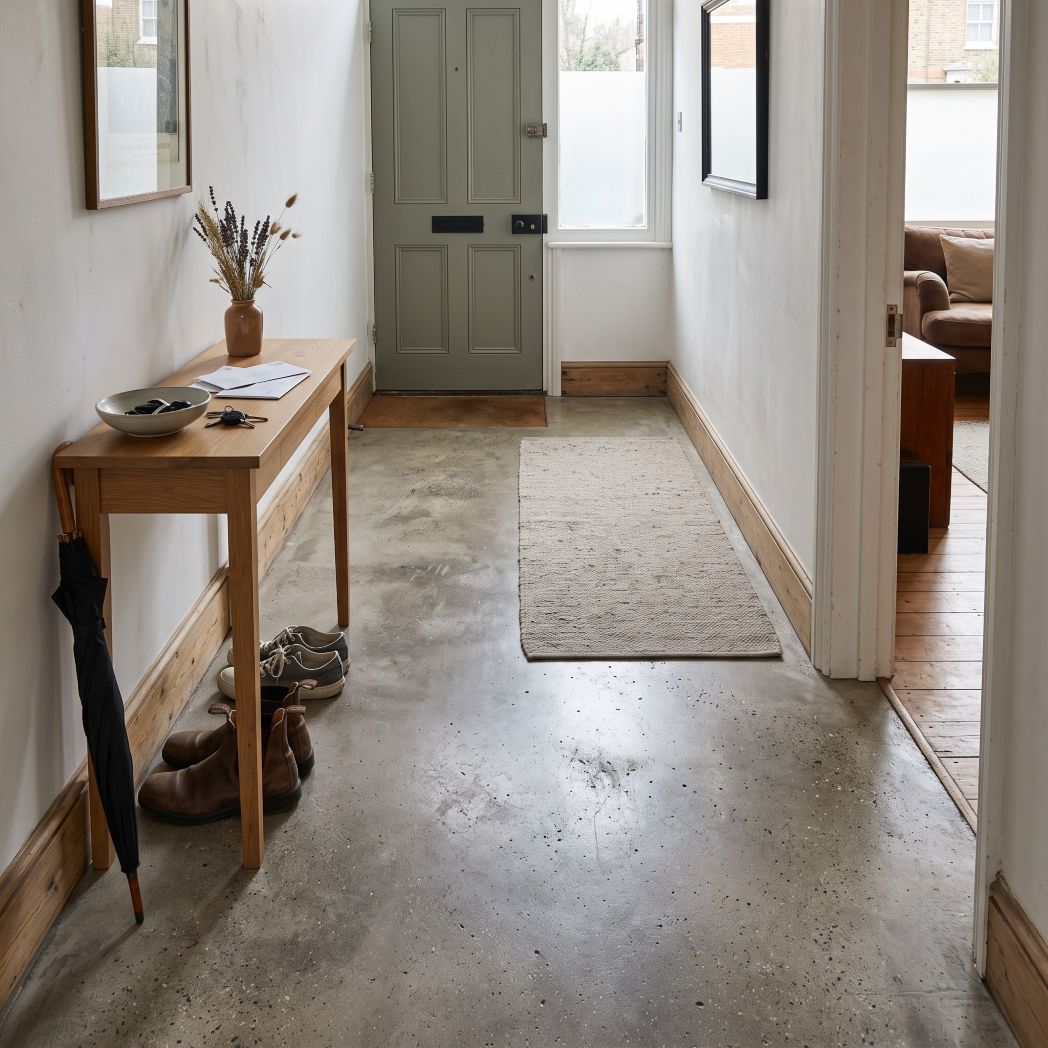
Polished concrete is the floor everyone wants in a warehouse conversion and almost nobody knows how to look after. It photographs beautifully – that pale, faintly industrial sheen running unbroken across a whole open-plan floor – and it gets sold on a promise of being wipe-clean and near-indestructible. That promise is where the trouble starts, because the way most people clean a “wipe-clean” floor is the quickest route to a dull one.
I’ll say it plainly, since it sets up everything else. Polished concrete is not low-maintenance. It’s one of the fussier floors you can live with in a London flat, and the developers who sell warehouse conversions on the “just mop it and go” line have never had to keep one looking good past the first winter. It rewards a light, regular routine and it punishes the wrong cleaner faster than almost any surface in the home. Sooner or later the wrong routine shows, and with concrete the damage tends to be permanent.
Before you clean it, you need to know which sort you’ve got, because “polished concrete” covers four or five finishes that want handling differently.
Which kind of “polished concrete” have you got?
There’s the real thing first: mechanically polished concrete, ground down with progressively finer diamond pads and hardened with a silicate densifier that soaks into the slab. The shine lives in the concrete itself. You can’t strip it, and you keep it up by burnishing rather than coating.
Then there’s the far more common one in flat conversions: a trowelled or power-floated slab with a film sealer laid on top – acrylic or polyurethane. Here the shine sits on a surface film. It wears and scratches, and eventually you strip it back and re-coat. If your floor was “sealed” by the developer, this is almost certainly what you’ve got.
After those, two more. A waxed or guard-coated floor carries a sacrificial layer buffed up over a sealer and topped up now and then. And microcement – a thin cementitious skin trowelled over an old floor and sealed – behaves like whatever sealer’s on it, and chips at the edges if it’s laid thin.
Which one you own decides everything downstream. It sets whether you can strip and redo the finish, and how it wants polishing back when it dulls. It also sets how much a spill threatens you: on a densified, mechanically polished floor the concrete is hardened all the way through, so a splash of wine wiped up quickly does little, while on a thin topical sealer or a microcement skin the same splash can mark through to the surface beneath if it’s left to sit. Two floors that look identical, two different tolerances.
The water-drop test that tells you
Put a few drops of water on a clean patch and watch. If it beads and sits on top, you’ve an intact sealer or a well-guarded surface doing its job. If the concrete darkens and drinks the water in within a minute, the sealer’s worn thin or gone, and you’re on notice: liquids will now soak in and stain, and the floor needs resealing before long. Do this once in a traffic lane and once in a corner nobody walks on, and the gap between the two tells you how worn the middle of the room has got.
What’s the daily routine that keeps it looking sharp?
Less than you’d think, done often. A dry dust-mop with a flat microfibre head, run over the floor most days, lifts the grit before it does any harm. That’s the main event. Once a week, a damp mop with a pH-neutral cleaner and a well-wrung head takes off the marks a dry mop leaves behind.
Wrung-out is the operative word again. A sopping mop leaves standing water that streaks as it dries and, on any worn patch, soaks straight in.
Why grit is the real enemy
Grit is sandpaper. Every grain of the fine stuff tracked in on shoes sits between a footstep and the floor, and every step drags it a fraction across the surface, scouring the polish or the sealer a hair at a time. It’s why the shine dies first in the doorways and the walking lanes while the edges stay bright for years.
The whole defence is stopping grit reaching the floor. A proper coir walk-off mat at every entrance – long enough that a person takes two or three strides across it, not a token square by the door – catches most of it. Take shoes off if the household will wear it. And dust-mop before the grit gets ground in, because once it’s scratched the surface, no mop lifts the scratch back out.
Two more scratch sources people forget. Furniture legs without felt pads score fine lines every time a chair drags back, so felt pads go on everything that moves, checked and swapped when they wear through to the tack. And the cheap rubber- or foam-backed mats, the kitchen sort, trap moisture against the surface and can leave a pale outline or discolour a sealed floor over a few months – a natural-fibre mat with a breathable backing sits kinder on concrete.
Which cleaners will quietly wreck a concrete floor?
This is where good intentions do the damage. Concrete is lime-based and alkaline, and acid is its enemy. Anything acidic etches the surface – eats a dull, rough patch into it that catches the light wrong and never polishes out by cleaning. Vinegar and lemon juice, and anything sold to shift limescale, are all off the table. So are the acidic spills people leave to sit: red wine, or a slice of lemon left face-down on the floor after a party.
Bleach is a separate problem – it can turn pale grey concrete blotchy and lift colour from a tinted floor. Ammonia and strong alkaline strippers pull the wax or sealer off. Even washing-up liquid, which people reach for as the “gentle” option, leaves a dulling film that builds up mop after mop.
pH-neutral, made for stone or concrete, wrung out. That’s the whole shopping list.
One caution on labels: “safe for stone” is a looser claim than it sounds, and some cleaners sold for tiles or natural stone come in mildly acidic. Look for pH-neutral in plain words, and if a product won’t tell you its pH anywhere on the bottle, treat that as a no.
The vinegar mistake
The vinegar thing deserves its own word, because the internet is full of “just use white vinegar” advice for every floor in the house, and on concrete it’s ruinous. Acid and lime react on contact. Wipe vinegar across a polished slab and you’ve traded a bit of surface dirt for an etched matt patch that’s now physical damage in the stone. No amount of scrubbing brings the shine back. It’s a re-polish, and that’s a specialist with a machine.
How do you deal with stains, oil and that white bloom?
Oil and grease are the ones that sink in, especially on a worn or unsealed patch – a dropped bit of cooking fat, bike chain oil in a hallway. Blot it rather than spread it, then draw it back out with a poultice: a paste of an absorbent powder and a solvent, spread over the mark, covered over, and left to pull the oil up into itself as it dries. It often takes two goes.
Rust from a metal plant pot or a tin left on the floor is its own job, and it wants a rust remover made to be concrete-safe, since the usual acidic ones etch.
Hard-water spotting turns up as well, on any London floor mopped with too much water and left to air-dry – the same chalk that furs a kettle dries as pale rings on the concrete. A wrung mop and a dry microfibre buff behind it stop them forming. Once they’ve built up, a pH-neutral cleaner worked with a white pad usually lifts them, though a sealer that’s drawn the mineral in can keep a faint ghost.
Efflorescence – the white haze in a basement conversion
Efflorescence is the white, chalky bloom that surfaces on concrete in damp, low-lying spaces – exactly the lower-ground and basement conversions London has carved out of old warehouses. Moisture moving up through the slab carries dissolved salts, the water evaporates at the surface, and the salt is left behind as a white haze.
Brush it off dry with a stiff brush and vacuum it up. Wet it first and you dissolve the salt and drive it straight back into the slab to bloom again. The real fix is the moisture underneath, which in a basement flat usually means a conversation about tanking and ventilation rather than anything you clean. I saw a bad case in a lower-ground flat in a Camden conversion, where the owner had been mopping the bloom back in weekly for months and feeding the problem.
When does it need resealing or professional attention?
A topically sealed floor is a wear item. The sealer thins in the traffic lanes over a few years. The water-drop test starts soaking instead of beading, the sheen goes patchy, and sooner or later that’s the point to strip and re-coat, or at least re-coat the worn zones. A densified, mechanically polished floor doesn’t get stripped – it gets burnished back up with diamond pads when it dulls.
The damage you can’t clean out
Some marks aren’t dirt. Etch from acid, scratches from grit, a deep oil stain in bare concrete – these are physical, sitting in the surface, and no cleaner touches them. They want grinding and re-polishing by someone with the kit.
I re-polished a lane through a warehouse flat on St John Street in Clerkenwell where the owner had spent two years mopping with an acidic “natural” cleaner and etched a dull grey track from the door to the kitchen. The concrete was sound. The surface was chewed. It took a specialist half a day with a machine to bring the shine back level with the rest of the room, and none of it needed to happen.